
Wake Me Up Before You Go-Go. SNOOZE grew a sense of time. Tap it once and Squachy hits the button for ten minutes, keep tapping and he rolls over for up to four hours. Meanwhile the T-Deck learned everybody's name on the Meshtastic mesh, introduced itself back, and got a settings page of its very own. "I'm not sleeping. I'm resting my eyes. Professionally."
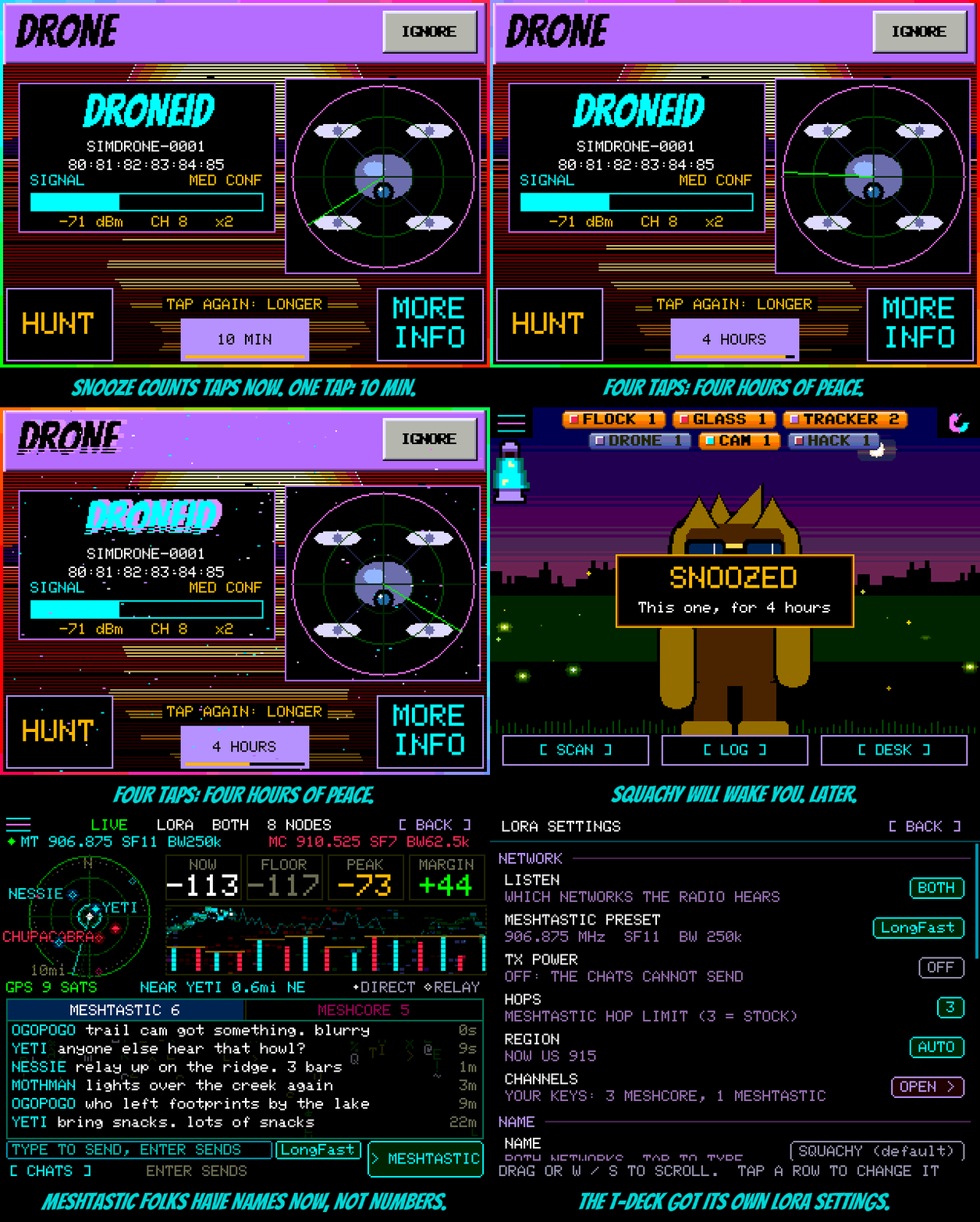
SNOOZE counts taps. On an alert, every tap on SNOOZE adds time: 10 minutes, 30 minutes, 1 hour, 4 hours, then round again. After the first tap the card says TAP AGAIN: LONGER, and any tap on the card counts as the next step, so a fat thumb can't wake the whole forest by accident. Three seconds after your last tap it locks in, and a note tells you exactly how long that device gets to be quiet. It's still just that one device, and it's still scanned and logged the whole time. Want it quiet forever? That's what IGNORE is for, and IGNORE can be undone from its list. Thanks to retrodroid32 for the timer underneath it all (PR #55).
Meshtastic names, both ways. Meshtastic texts only carry a node number, so the chat used to read like a phone book with the names torn out. Now the T-Deck catches each node's name when it's announced, fixes up the messages it already showed, and remembers up to 48 names across a restart. And it introduces itself before its first message, so the other side sees SQUACHY instead of a string of hex. The short name is SQWT until you give him a real one. "Hello. My name is SQUACHY. You may have read about me in the papers."
The T-Deck's LORA SETTINGS. On the LORA page, tap SET in the top-left corner. One name for both networks, which networks to listen to, the Meshtastic preset, hops, region, a message sound, whether detections keep running while you chat, and whether alerts pop up over the LORA pages. CHANNELS holds your private channel keys.
Pick a channel. A chip on the line you type into steps through the channels you can send on. Outlined is the public channel, filled is a private one. If a private channel can't be sent on, the message isn't sent, so it can never leak out on the public one.
Freenove S3 fixes. The Freenove ESP32-S3 2.8" had been rebooting at random. bobsdinner-cell traced it to the screen's data line being let go mid-frame, and the T-Deck's fix for the same trap now covers it too (PR #71). They also built a 40 MHz firmware for the panels that tear at full speed (PR #65): on the flasher, pick the Freenove 2.8" and untick 80 MHz under Advanced. And they built a printable case with a press-fit lid, a speaker pocket and a thumb recess for the TF card (PR #68, in enclosure/freenove-s3-28).
The DIYmalls 2.8". The JC2432W328C now has its own entry in the flasher and answers to its board code, running the same ST7789 build as the original CYD. Thanks to AmandaHernow (PR #58), who also wrote it a page in docs/DIYMALLS-28.md.
SquachWatches in the Wild. squachwatch.com now shows a running count of installs. No names, no addresses, no tracking: just a number going up. Squachy finds it very validating.
Coming soon: the M5Stack Tab5. Its big 1280x720 screen, touch, WiFi and Bluetooth all work through its separate radio chip, and SquachMesh visits too. It's on the test flasher (squachwatch.com/?lab=1) while the rest catches up. See docs/TAB5.md.
The actually-useful part
Added
- Alert SNOOZE steps 10 MIN, 30 MIN, 1 HOUR, 4 HOURS per tap and locks in 3 s after the last tap; TAP AGAIN: LONGER after the first tap; while picking, any tap on the card is the next step; the note names the time. Timed snooze per device built on PR #55 by retrodroid32.
- T-Deck: LORA SETTINGS from SET on the LORA page: name (one for both networks), listen, Meshtastic preset, hops, region, message sound, detections ON / OFF ON LORA PAGE / OFF, on-screen detections (pop-ups on the LORA pages, default on), channels.
- T-Deck: a channel chip on the compose line (LORA page and chats) picks the channel a message goes out on.
- Meshtastic: names from NodeInfo rename earlier chat rows and are kept across restarts (48); the T-Deck announces its own NodeInfo before its first text and again after 3 hours; short name SQWT until a name is set.
- Freenove ESP32-S3 2.8": a 40 MHz build,
freenove-s3-40mhz, on the flasher by unticking 80 MHz under Advanced (PR #65 by bobsdinner-cell). - Freenove ESP32-S3 2.8": a printable case in enclosure/freenove-s3-28 (PR #68 by bobsdinner-cell).
- Flasher: DIYmalls 2.8" JC2432W328C option and board code, on the CYD ST7789 build; docs/DIYMALLS-28.md (PR #58 by AmandaHernow).
- Flasher: SquachWatches in the Wild, an install count.
- M5Stack Tab5 on the test flasher (?lab=1): screen, touch, WiFi and Bluetooth through the C6; docs/TAB5.md.
Changed
- SNOOZE is no longer "until the board restarts": it lasts the time you tapped (one tap = 10 minutes).
Fixed
- Freenove ESP32-S3 2.8": random reboots, from the panel's SPI bus being released mid-frame (PR #71 by bobsdinner-cell).