
Radar Love. The T-Deck got a page all its own for the radio: a radar, a line with a meteor on it, and both chats on one screen. Squachy now stares at it the way other people stare at a fireplace. He also learned some new noises, and stopped calling a desk sign a hacker.
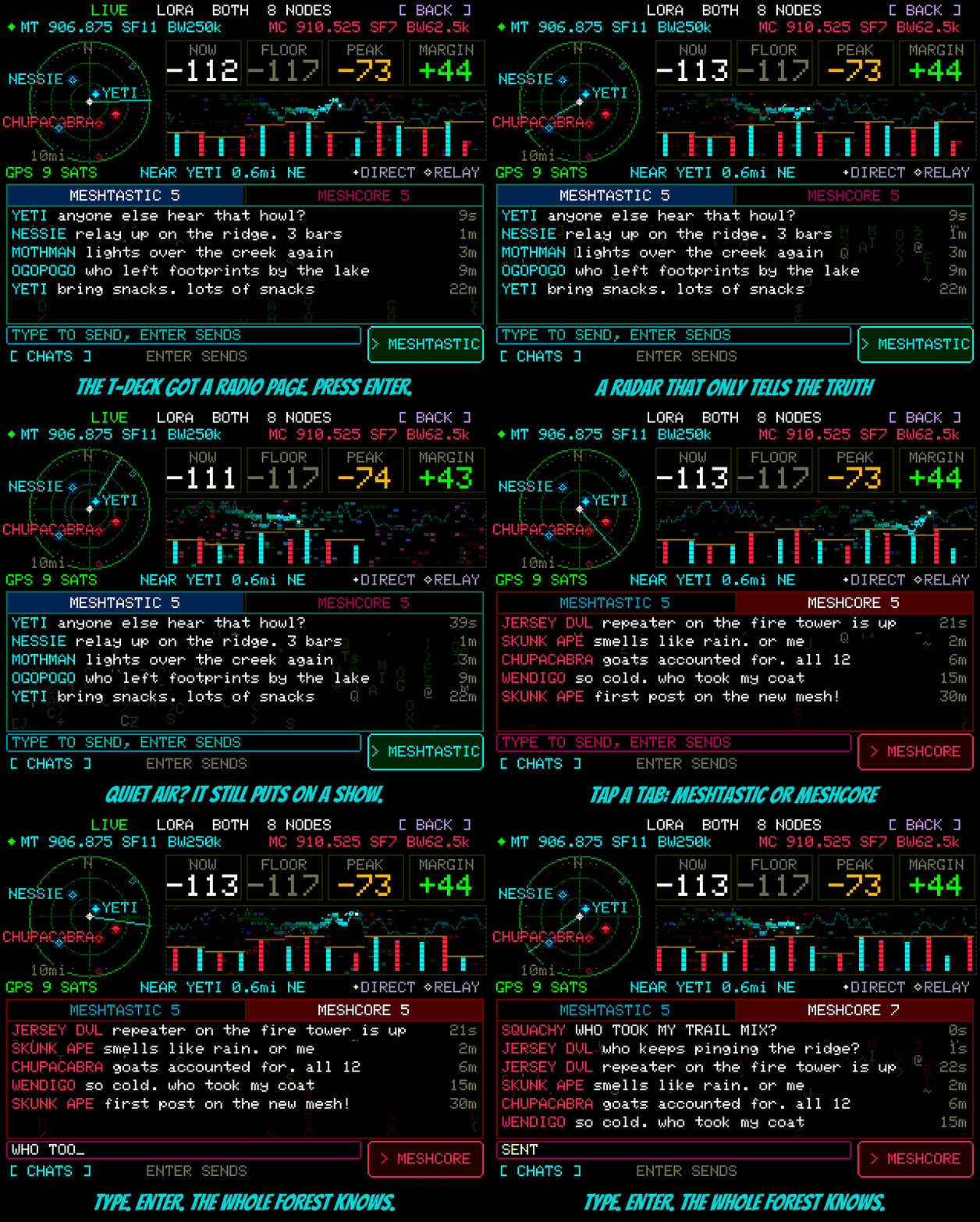
The LORA page. On the T-Deck, press Enter on the main screen, or tap the LORA pill, which now stays up whenever the radio is on. On the left, a radar of every node in earshot, with a ping rippling out every few seconds. On the right, NOW, FLOOR, PEAK and MARGIN, and the last 80 seconds of air as a glowing line with each packet as a spike in its network's colour. Underneath, one chat window with a tab for Meshtastic and one for MeshCore, and a line to type into that sends to whichever tab is open. BACK lives up in the top-right corner, well away from your thumb.
An honest radar. A node that has sent its position sits at its real bearing and distance once the T-Deck has a GPS fix. A node that hasn't waits on the dotted rim, because one little antenna cannot tell which way a signal came from, and Squachy refuses to make it up. Filled dots were heard directly, hollow ones only through relays, and a loud signal is never drawn as a close one. The line under the radar tells you what the GPS is doing in plain words, so nobody has to guess what "NO POS" meant. (A tester did. It meant the other node. Sorry, tester.)
Quiet air, still a show. Out on a quiet hill, a meteor sweeps the line from left to right, throwing off sparks. Behind it, a field of colour in your own theme twinkles and drifts, and every packet leaves a glow in its network's colour that slides away with it. The last packet keeps echoing for two minutes like it can't take a hint. And a faint code rain falls in the chat window, cyan for Meshtastic, pink for MeshCore.
Said once means once. People were seeing every Meshtastic message two or three times: one row for each relay that passed it along, and sometimes your own message coming back at you. Now each message gets one row, however many hilltops repeat it.
The T-Deck's GPS speaks up. Its GPS talks at a different speed from the one Squachy was listening at, so a two-hour walk logged nothing at all. Now he tries both speeds until it answers: a fix 21 seconds after boot on the bench. And the amber GPS SEARCHING that flickered for one frame every second, even with a fix, is gone. That one was a clock that thought the fix was 49 days old.
New noises. On the boards with a speaker (the Freenove 2.8" and 3.5", and the T-Deck), a watch-list hit is now the Bigfoot whoop, twice, with an echo off the next ridge. Messages chime like glass, visitors knock knock, C1iPPY goes sproing, plugging in swoops up and unplugging sighs back down, and a low battery sounds like a wind-up toy running out. T0@$TY lands with a tin clank and the yeti lands with a grumpy oof. Everything is made from a recipe on the fly, so not one recording takes up room.
The BUSY Bar is not a hacker. It's a desk sign made by the people who make the Flipper Zero, and it borrows the Flipper's WiFi addresses and Bluetooth ID, so Squachy kept accusing it of crimes. Three real Flipper Zeros on the bench never send either one. They're still caught by their own Bluetooth signature and name, and the desk sign can get back to telling people you're busy.
Calmer deauth alarms. Six kick-off frames in three seconds from anyone used to raise the alarm, and some home routers do that all on their own when they shuffle phones between bands. Now it takes twelve from one sender, or six aimed at everyone at once, which routers almost never do and attack tools almost always do.
Older builds, easy to find. On squachwatch.com, the version picker sits right under the board-code box again instead of hiding under Advanced. They were never gone, just shy.
The actually-useful part
Added
- T-Deck: the LORA page. Opened by Enter on the main screen or by the LORA pill, which stays up while the radio is on: a radar of nodes (real bearing and log distance with a GPS fix, rim otherwise; filled = direct, hollow = relayed), a radial ping, NOW/FLOOR/PEAK/MARGIN tiles, an 80-second strip with packet spikes and a ten-second peak hold, the GPS and nearest node under the radar, one chat window with MESHTASTIC and MESHCORE tabs, a compose line that sends to the open tab, BACK top-right.
- The strip on a quiet band: a meteor with sparks on the noise line, a twinkling field in the theme's colours, packet glow that drifts and cools, the last packet's echo for two minutes. Code rain in the chat window in the open tab's colour.
- Sounds: watch-list hit (Bigfoot whoop, echoing), squad Heads-Up whoop, message (glass), visitor (knock knock), C1iPPY (spring), cable in/out (warm swoop/fall), low battery (toy winding down), T0@$TY landing (clank), yeti landing (oof).
Changed
- DEAUTH: 12 deauth or disassociation frames in 3 s from one transmitter, or 6 to the broadcast address (was 6 from anyone).
- HACKER: Flipper's company ID
0x0E29and IEEE block0C:FA:22no longer match; Flipper Zeros are caught by their service UUIDs and name. - GPS on the CYD path tries 9600 and 38400 baud in turn until a sentence parses (the T-Deck Plus's GPS runs at 38400).
- Flasher: the version picker is under the board-code box, not under Advanced.
Fixed
- LoRa chats: one row per message, not one per relayed copy or for your own echo (Meshtastic by sender + packet ID, MeshCore by sender, time and text, within ten minutes).
- GPS SEARCHING no longer flickers over a good fix: a fix parsed later in the same frame read as 49 days old.