
Blast Processing. Sega's word for speed, and this release is nothing but: the main screen runs at thirty frames a second on the 80 MHz boards and the whole device draws faster — and not one pixel of it looks different, except Squachy, who was asked to slow down.
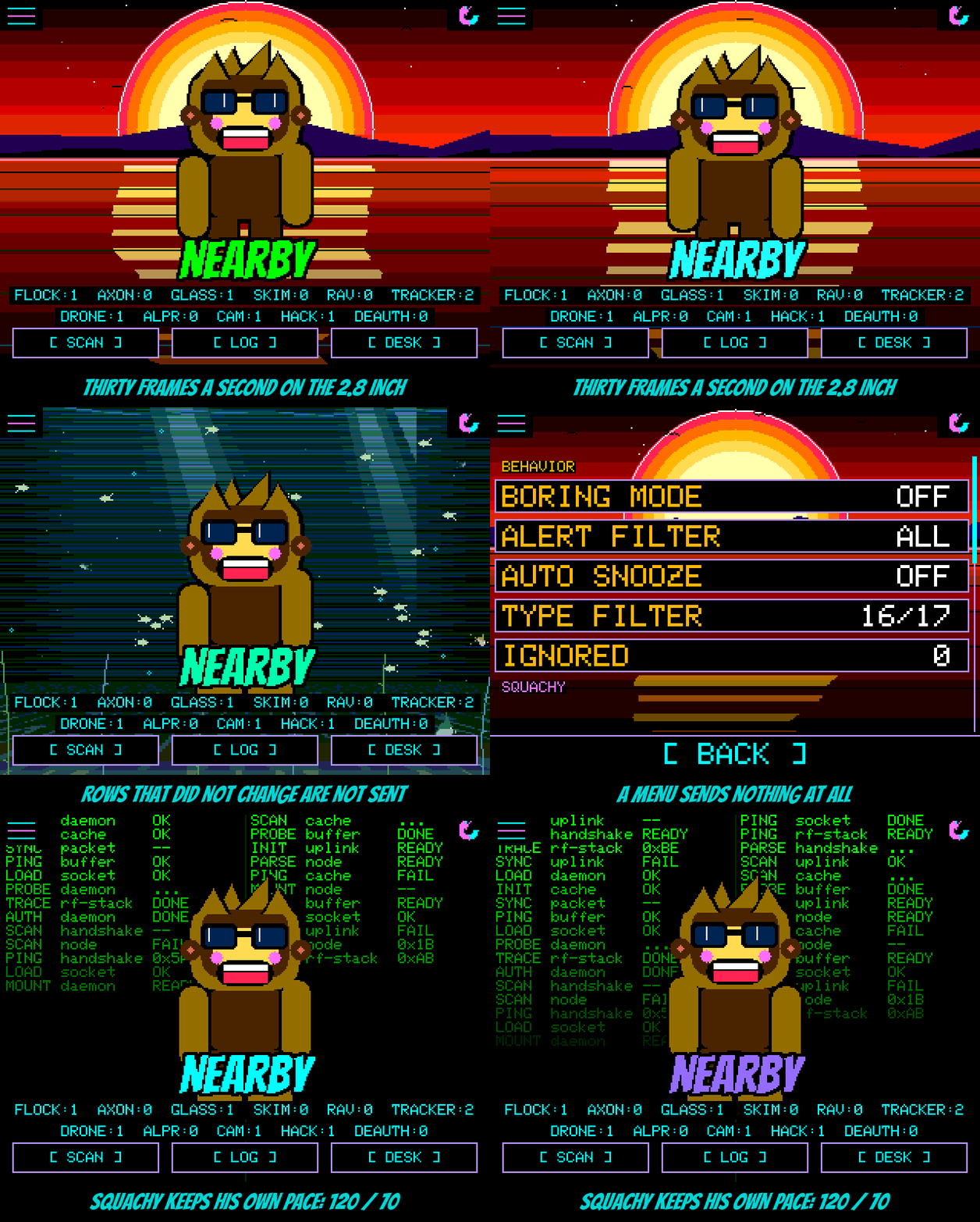
Rows that did not change are not sent. Every frame used to go to the panel whole, and the panel is the slowest thing on the board. Now one hash per row remembers what the panel already shows, and a row that has not changed stays where it is. On a menu that is every row, and the push costs nothing at all. On the main screen it is the title bar, the counters and the buttons — about a third of the screen — repainted identically every frame by code that never knew they did not change. The 80 MHz boards went from 21 to 30 frames a second on the main screen; the 40 MHz ones, whose wire is twice as slow per row, gained the most per row skipped.
Squachy keeps his own pace. He, the crowd, a visitor and the idle events used to step once per frame, tuned by eye on a board that drew sixteen of them a second — so the day the frame rate doubled, they ran at double speed. They step on their own clock now, whatever the screen is doing, and the screen still draws them every frame. That alone read as barely slower, because his behaviour is scheduled in milliseconds — how long a mood lasts, how long a bubble stays, how often an idle gag fires, the length of a drop or a stretch — and none of that changed with the frame rate; each thing just got twice the frames, which reads as brisk. So every one of those durations is on one percentage now.
Both were chosen by eye, and both are yours to change. PACE N on the console is milliseconds between his steps; TEMPO P is the percentage on his durations. Two boards side by side settled on 120 and 70, against the 62 and 100 as written, and those are the defaults. Either is kept in settings across reboots and flashes.
The frame line names its background. The serial timing line says which background it was measured on — which is how it came out that one board had been on the aquarium all along, that SYNTHWAVE costs three times as much by day as at night because it has a sunset, and that a two-millisecond mystery next to Squachy was a squad member standing beside him.
The actually-useful part
Added
- PACE N and TEMPO P on the console: the mascot's step interval in milliseconds and a percentage on all his durations, both kept in settings.
- The serial frame line reports the background it measured and the rows it sent.
Changed
- Only rows that changed are sent to the panel; a full refresh still happens every 64th frame and after any rotation.
- Main screen: 21 to 30 frames a second on the 80 MHz boards; the 40 MHz boards gain most on menus and lists, which now send nothing.
- Squachy, the crowd, visitors and the idle events step on their own clock (default 120 ms) instead of once per frame; every duration of his runs at 70% by default.
Fixed
- Squachy running at double speed on the boards that got fast.