
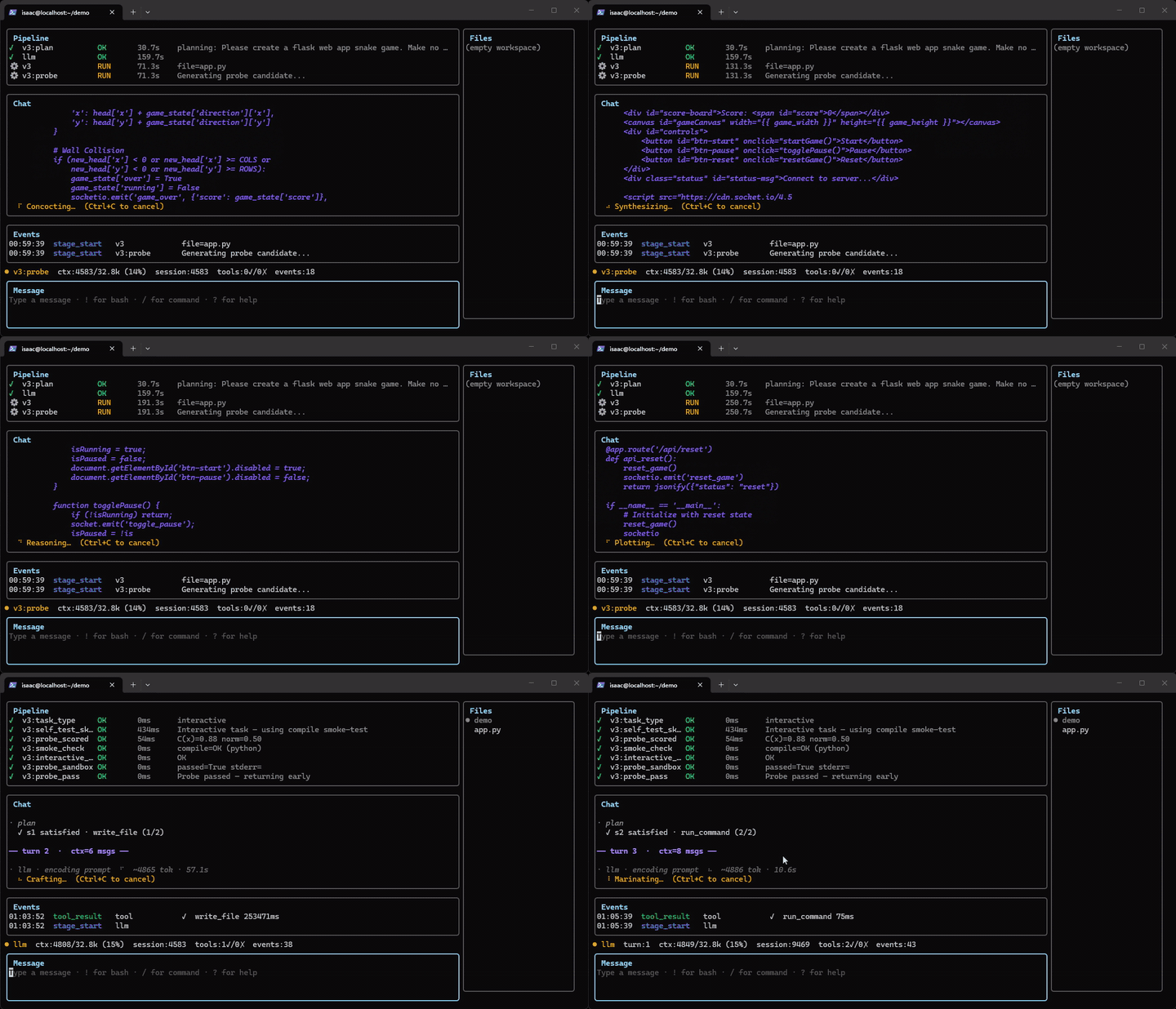
The ATLAS TUI live, 10× sped up, running the V3 pipeline on a file creation.
V3.1.2 stays in the Maia line. It broadens hardware reach (run ATLAS on AMD, Apple Silicon, Intel, or CPU — not just NVIDIA), closes the bring-your-own-model gap (train Lens + ASA artifacts for any GGUF, including from your own usage), and lands a focused agent-reliability pass that fixes the failure modes that used to silently break a turn on a local 9B. Less new surface, much higher hit-rate per turn.
What shipped
Hardware reach
- AMD ROCm via llama.cpp — including RDNA4 / RX 9070 (gfx1200/gfx1201) (#26)
- Apple Silicon — native macOS hybrid Metal path (native llama-server for inference, Docker for the rest) (#32)
- Vulkan universal fallback — one image covering AMD / Intel / Snapdragon / Apple-via-MoltenVK / CPU (#114)
Bring-your-own-model
atlas lens build/atlas lens retrain— local Lens training pipeline; train C(x)+G(x) for a non-default GGUF from bench candidates or from your own rated sessions (#100)atlas asa check / build / publish— per-model ASA control-vector calibration parity (#113)- Per-model lens thresholds — off-rails / regression cutoffs now ship with the lens artifact (
gx_thresholds.json), auto-calibrated per model, so the lens fires correctly regardless of a model's score scale
In-the-loop lens training
- Rate a pass in the TUI —
/good·/bad(pass-level) and/review+/deny·/accept(per-file) — and the proxy banks weighted, labeled samples. A "retrain available" banner surfaces when enough accumulate, thenatlas lens retrainlearns your actual workloads.
Agent reliability
- Tool-result visibility — Gemma's chat template silently dropped
role:"tool"messages, so the model never saw tool output and looped; results now render as user turns (model-agnostic). This was the big one. - read-dedup false-negative fix; traceback → directed edit (#39 option 3);
move_filetool; pip-install and case-mismatch steers; per-turnmax_tokens+ content-loop bounds - Sandbox: shell gate narrowed to catastrophic-only (the container is the real boundary); host-sized cgroup limits (mem + pids); interactive V3 wall-clock cap
Structural reasoning & docs
- Call-graph reasoning (#39 / #125) — intra-file call edges on
outline_file/read_file, a Datalog solver,ast_editfriendly selectors (now incl.<script>/<style>), cyclomatic-complexity tiering - ARCHITECTURE.md translated to zh-CN / ja / ko (#25)
Full line-by-line: CHANGELOG.md.
Closed in this release
- #26 ROCm · #114 Vulkan · #65 GPU vendor lock-in
- #100
atlas lens build· #113atlas asa check/build/publish - #25 ARCHITECTURE.md translations
Substantially advanced
- #39 Structural code reasoning — call graph + Datalog solver +
ast_editshipped; the solver-backed reachability tail continues into V3.2
Thank you
Contributor: @yogthos (Dmitri Sotnikov) — #125 structural call-graph reasoning (the #39 foundation), with #124 RPG planning in review for V3.2.
Sponsor on GitHub keeps this sustainable.
Next — V3.2
Architecture-first RPG planning (#120 / #124); solver-backed reachability + wavelet retrieval (#39); reasoning-with-sampling (#9); automated HF submission (#102); ROCm-on-K3s; formal 9B benchmarks (#28).
Maia — first of the Pleiades, Atlas's eldest daughter. The V3.1.x line stays in the Maia series; V3.2 opens the next.