
What's new in 1.8.3
- The DVB card's header on every mode. Each decoder's panel now opens the way DVB-S2's does: a title bar with the mode, the space-segment frequency and the symbol rate (the VFO's width for a mode with no symbol rate), green once the carrier is locked, half lit while it is not, grey while it waits. Under it, a demodulated carrier's modulation and code in large type with its Es/N0 beside it and on a bar, then Es/N0, Eb/N0 and the residual offset; the analogue modes, Spectrum and the IQ recorder show the VFO's level on the bar instead.
- Less repeated in the modem cards. The TPC, Viterbi, FastLink and generic PSK cards no longer list the carrier's lock, Es/N0, residual offset and symbol rate again: the header has them.
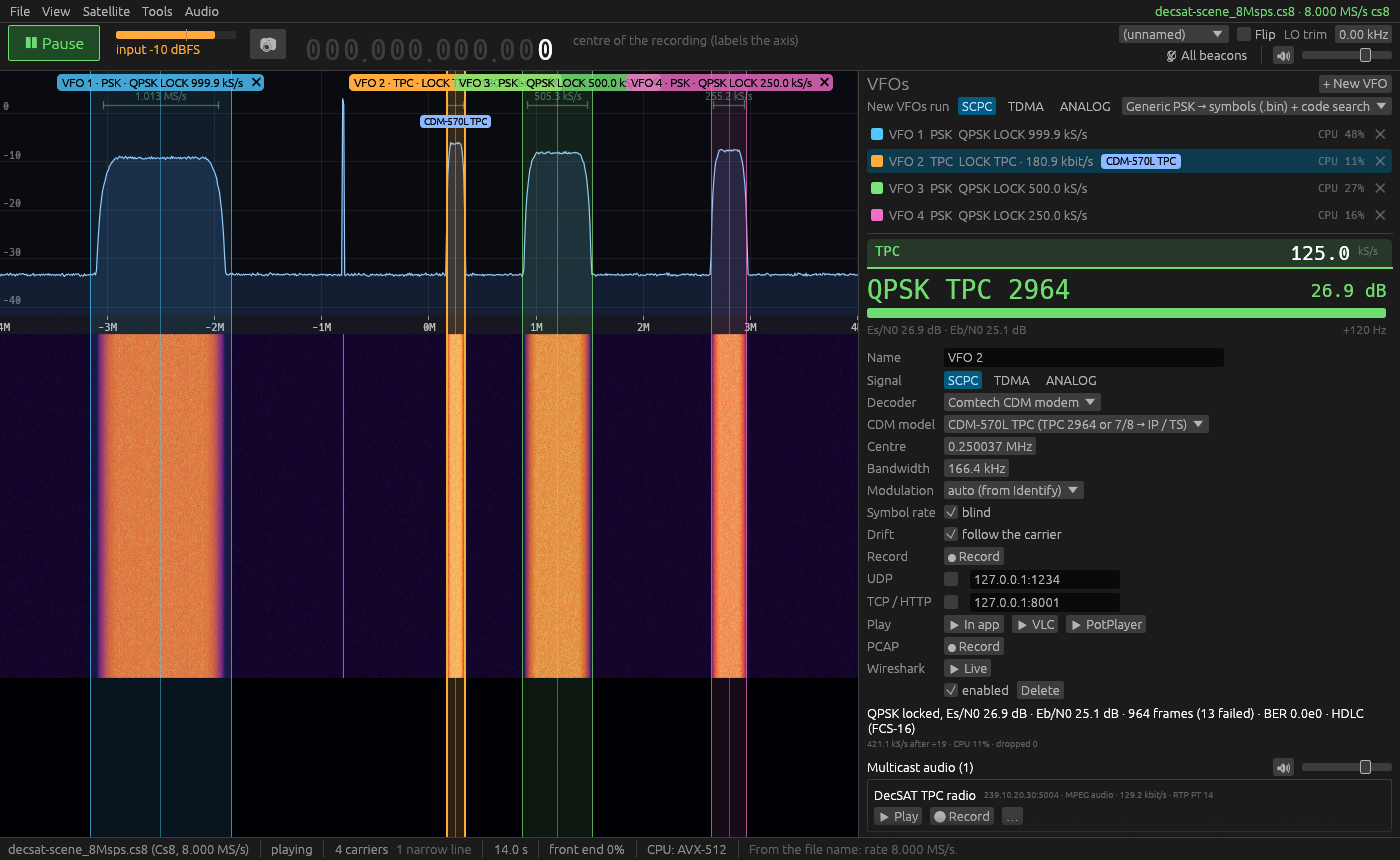
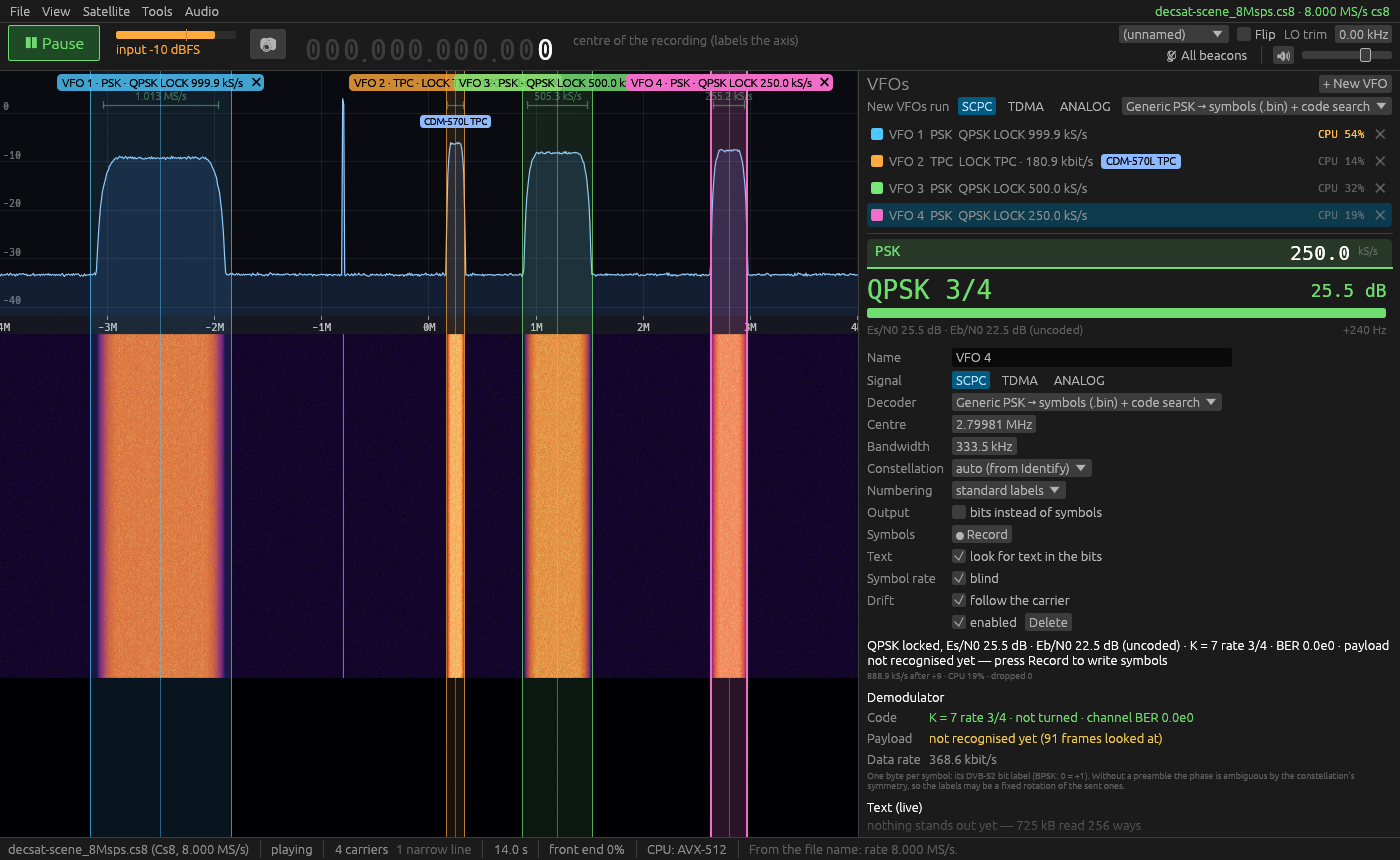
Both pictures are the test signal decsat-scene_8Msps.cs8 below.
Portable Windows executables for 64-bit Windows 10/11, nothing to install (static C runtime).
| File | What |
|---|---|
decsat-gui.exe
| Desktop app: wideband waterfall with VFOs (DVB-S2/S2X → GSE/IP or MPEG-TS, DVB-S, satellite modems, DVB-CID, generic PSK/QAM, IQ record), IQ files or a HackRF One; a DVB-S2/S2X transmitter (MPEG-TS to the HackRF or a file) |
qo100-beacon.exe
| QO-100's 400 bit/s PSK beacon from a sound card: waterfall, frames, text and housekeeping values |
decsat-tx.exe
| Transmitter: a webcam and microphone (or a video file) encoded live in H.264, H.265, H.266, AV1 or MPEG-2 by ffmpeg, on a DVB-S2/S2X carrier with QO-100 presets, to the HackRF or an IQ file (needs ffmpeg) |
decsat.exe
| Command line: decsat scan, decsat decode, decsat analyse, decsat scene, decsat cid, decsat test-signals, decsat tx, decsat record, decsat modcods
|
decsat-server.exe
| Headless SDR server: serves a radio at the dish to decsat-gui or decsat over one TCP connection (see docs/REMOTE.md)
|
decsat-server-app.exe
| The same server in a window: double-click, choose who can connect, press Start |
decsat-scene_8Msps.cs8
| Test signal, 8 MS/s, 4 s: DVB-S2 (IP over GSE, and an S2X ACM carrier with MPEG-TS), DVB-S, a TPC 2964 modem carrier and a CW tone |
decsat-cid_3360000sps.cs8
| Test signal, 3.36 MS/s, 30 s: DVB-S2 QPSK 1/2 at +700 kHz with a DVB-CID under it (identifier and position decode) |
Open a test signal in the GUI (Open IQ…; the sample rate is in the file name) and click a carrier, or run decsat test-signals to make them yourself (tests/README.md).
A HackRF One needs no DLLs (it transmits only when armed: see the README); on Windows it must use the WinUSB driver (Zadig, or the one the official HackRF tools install). IQ files need nothing.
Windows SmartScreen may warn on first start because the files are unsigned ("More info" → "Run anyway").
Built from f1af90a by GitHub Actions.
SHA-256:
f2aa44bc22d2c3973a2cfa133bced960b371a599cbb43e1b3cf72a39093a8237  decsat-gui.exe
3183e1f3939dc4f69437c4b2bc02b9ea84a92528f56ae46a9f3215a5bdddc55f  decsat.exe
72109360c0d40b3ab27610b9ca9b9f34a961491b4b0330f7544da53ab0302563  decsat-tx.exe
774d089bee02eef4b421aa7787fae4b1cedab6bcecc0c80ed7017ee852c21b93  decsat-server.exe
4e9a18105e2786e6d21a260c2e4edd1e79d1deb68e4bd7bcd5985b87491e339c  decsat-server-app.exe
957e0ee9f753b336dda3dee80d489c90de7bb00b6ff1abaeff0e96ca419cc400  qo100-beacon.exe
81491d2ab66896a378df1cd642bc49793ffbf45bfcadfe6e09fd3f18fed30184  decsat-scene_8Msps.cs8
d1d2850158b9fd2f78e91c49043413c83942652a2faa551ccac161a4241f0dfb  decsat-cid_3360000sps.cs8