
What's new in 1.12.0
A finer spectrum when you zoom in
- The waterfall and the trace sharpen as you zoom. Once a pixel is narrower than one FFT bin, the part of the band on screen is transformed again at a bin a pixel, down to 1 Hz bins. A 20 kHz view of a 5 MS/s recording used to be 16 blocks across; it is now resolved to 20 Hz.
- The wheel goes much further in: to a 500 Hz view, where it used to stop at 32 FFT bins.
- Nothing blanks while you zoom or pan. The finer picture is laid over the waterfall's own and fills in as its samples arrive.
- Levels stay put: noise and carriers keep their colours at any zoom; only a steady tone stands higher the finer it is resolved.
- Deep in, rows are slower: at the deepest zooms each row is one transform up to a second long, so a short burst is smeared over that time.
- No extra CPU that shows (measured on a 5 MS/s recording). Local sources only; a remote server's waterfall is drawn as sent.
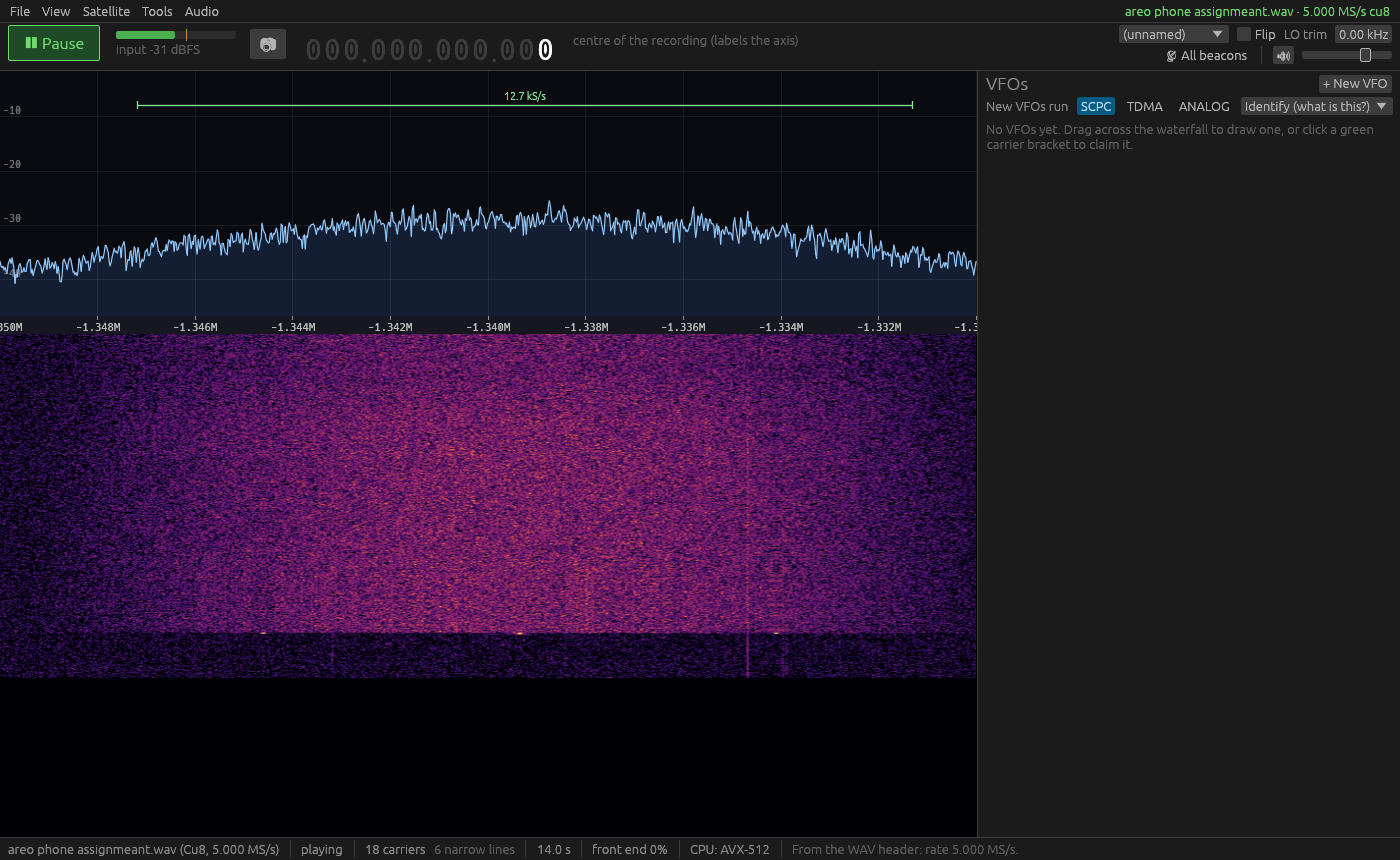
Inmarsat BGAN (#73, by devttys0)
- IP packets split into link-layer segments are rebuilt. The carver could not see them: 157 lost against 395 carved on a 23-minute recording.
- Fixed: a PCAP cut short at exit, and corrupt carved packets.
decsat-gui --view LO_HZ:HI_HZ sets the view for unattended runs.
Portable Windows executables for 64-bit Windows 10/11, nothing to install (static C runtime).
| File | What |
|---|---|
decsat-gui.exe
| Desktop app: wideband waterfall with VFOs (DVB-S2/S2X → GSE/IP or MPEG-TS, DVB-S, satellite modems, DVB-CID, generic PSK/QAM, IQ record), IQ files or a HackRF One; a DVB-S2/S2X transmitter (MPEG-TS to the HackRF or a file) |
qo100-beacon.exe
| QO-100's 400 bit/s PSK beacon from a sound card: waterfall, frames, text and housekeeping values |
decsat-tx.exe
| Transmitter: a webcam and microphone (or a video file) encoded live in H.264, H.265, H.266, AV1 or MPEG-2 by ffmpeg, on a DVB-S2/S2X carrier with QO-100 presets, to the HackRF or an IQ file (needs ffmpeg) |
decsat.exe
| Command line: decsat scan, decsat decode, decsat analyse, decsat scene, decsat cid, decsat test-signals, decsat tx, decsat record, decsat modcods
|
decsat-server.exe
| Headless SDR server: serves a radio at the dish to decsat-gui or decsat over one TCP connection (see docs/REMOTE.md)
|
decsat-server-app.exe
| The same server in a window: double-click, choose who can connect, press Start |
decsat-scene_8Msps.cs8
| Test signal, 8 MS/s, 4 s: DVB-S2 (IP over GSE, and an S2X ACM carrier with MPEG-TS), DVB-S, a TPC 2964 modem carrier and a CW tone |
decsat-cid_3360000sps.cs8
| Test signal, 3.36 MS/s, 30 s: DVB-S2 QPSK 1/2 at +700 kHz with a DVB-CID under it (identifier and position decode) |
Open a test signal in the GUI (Open IQ…; the sample rate is in the file name) and click a carrier, or run decsat test-signals to make them yourself (tests/README.md).
A HackRF One needs no DLLs (it transmits only when armed: see the README); on Windows it must use the WinUSB driver (Zadig, or the one the official HackRF tools install). IQ files need nothing.
Windows SmartScreen may warn on first start because the files are unsigned ("More info" → "Run anyway").
Built from a64ff5d by GitHub Actions.
SHA-256:
ef65245707b7d368f3d60ae54717dd15872e8f1385eb22ba06d27e4b12df27c3  decsat-gui.exe
609744f05787e309445b6254b5473dfc71d27a45de2d8829a28989319a729878  decsat.exe
a4db25f6bcbd2adce30ba80ff0cba58ab170b14d2c7a3bbddc77e473ca153263  decsat-tx.exe
bbbde229a4f7e4c40df71688dc5cb97e114d461714784ecec284436cd9554b42  decsat-server.exe
67ec90d17d0a2190236c8fa8e7083faa8deeb5288e9155ad421fa98a58442830  decsat-server-app.exe
8de7f45099baf83c309b75b8c81e26d2026aa8e7e2c2f6f065306a68ee1b03da  qo100-beacon.exe
81491d2ab66896a378df1cd642bc49793ffbf45bfcadfe6e09fd3f18fed30184  decsat-scene_8Msps.cs8
d1d2850158b9fd2f78e91c49043413c83942652a2faa551ccac161a4241f0dfb  decsat-cid_3360000sps.cs8